Why Walking Through 35,000 Chickens With A Clipboard Is Outdated: How Smart Poultry Farms Use AI Cameras To Track Flock Health
In punishing tropical heat and humidity, a single ventilation hiccup can wipe out an entire flock in hours. Here’s how ceiling-mounted CCTV cameras and AI weigh broilers contactless, spot sick birds early, and keep 35,000 chickens thriving.
In commercial poultry farming, margins are dictated by fractions of a gram. Broiler chickens have no sweat glands. In tropical environments where ambient daytime temperatures regularly exceed 34°C with 80% relative humidity, a flock's internal thermoregulation collapses. When air velocity drops in a crowded tunnel house, core temperatures spike within 90 minutes, triggering acute respiratory alkalosis and mass mortality.
Simultaneously, feed accounts for 65% to 70% of total operational expenditure. Traditional weight auditing requires farm workers to enter sheds with catching pens and hanging spring scales, manually sampling 50 to 100 birds. This invasive process induces severe stress, pauses feeding for several hours, and introduces sampling bias because workers naturally grab slower, heavier birds.
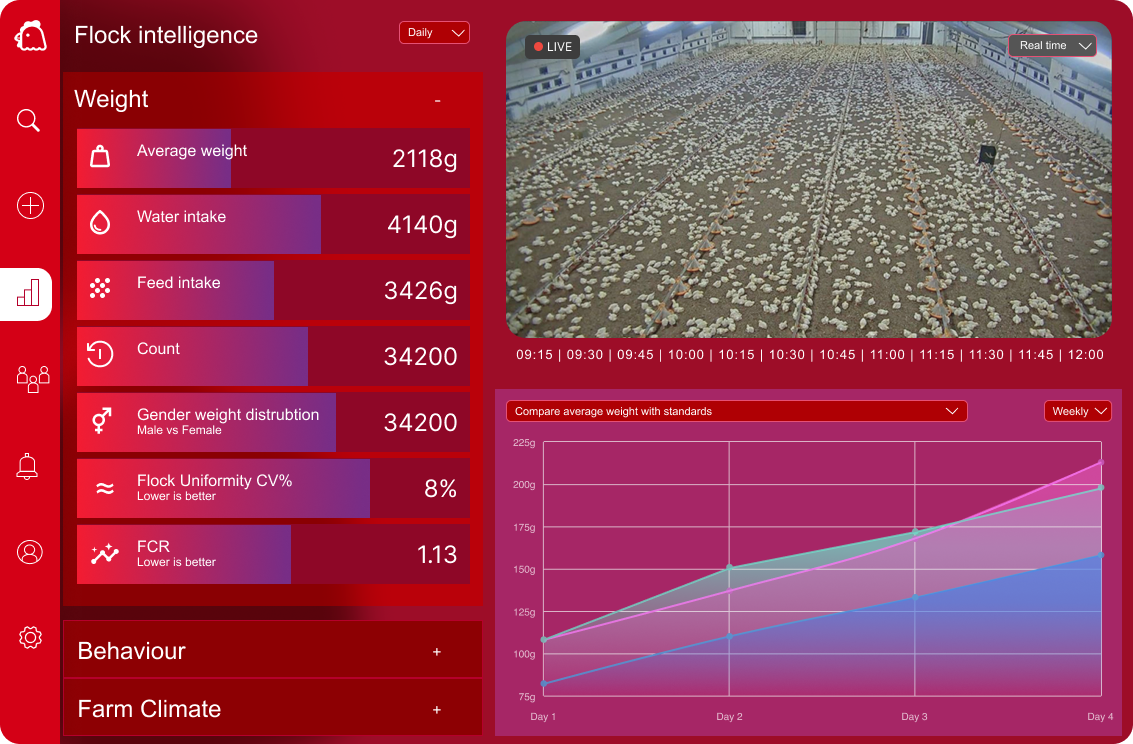
Top Problem Areas in Commercial Broiler Operations
Through field audits across modern commercial contract poultry operations, four operational points of failure repeatedly degrade farm profitability:
| Operational Bottleneck | Traditional Farming Method | SmartPoultry Visual AI System |
|---|---|---|
| Flock Weighing | Manual catching scale. 50 birds caught once per week. Stresses entire shed, biases sampling. | Contactless optical volume. Thousands of birds measured 24/7 via overhead camera AI. Zero stress. |
| Heat Stress Response | Worker walk-throughs. Inspections occur every 3–4 hours. Fans adjusted manually after mortality begins. | Continuous panting & huddling AI. Vision model detects bird dispersion shifts; auto-triggers tunnel ventilation in seconds. |
| Ammonia (NH₃) Creep | Human olfactory check. Workers only detect ammonia once levels exceed 25–30 ppm, causing respiratory damage. | Electrochemical LoRa telemetry. Sub-ppm detection alerts operators at 15 ppm before cornea or tracheal damage occurs. |
| Harvest Sizing Uniformity | High weight scatter (CV > 14%). Uneven birds cause processing plant rejection penalties. | Tight CV tracking (8.0%). Feeding line speed adjusted dynamically to maintain uniform growth. |
Visual AI Architecture & Dedicated Red Command UI
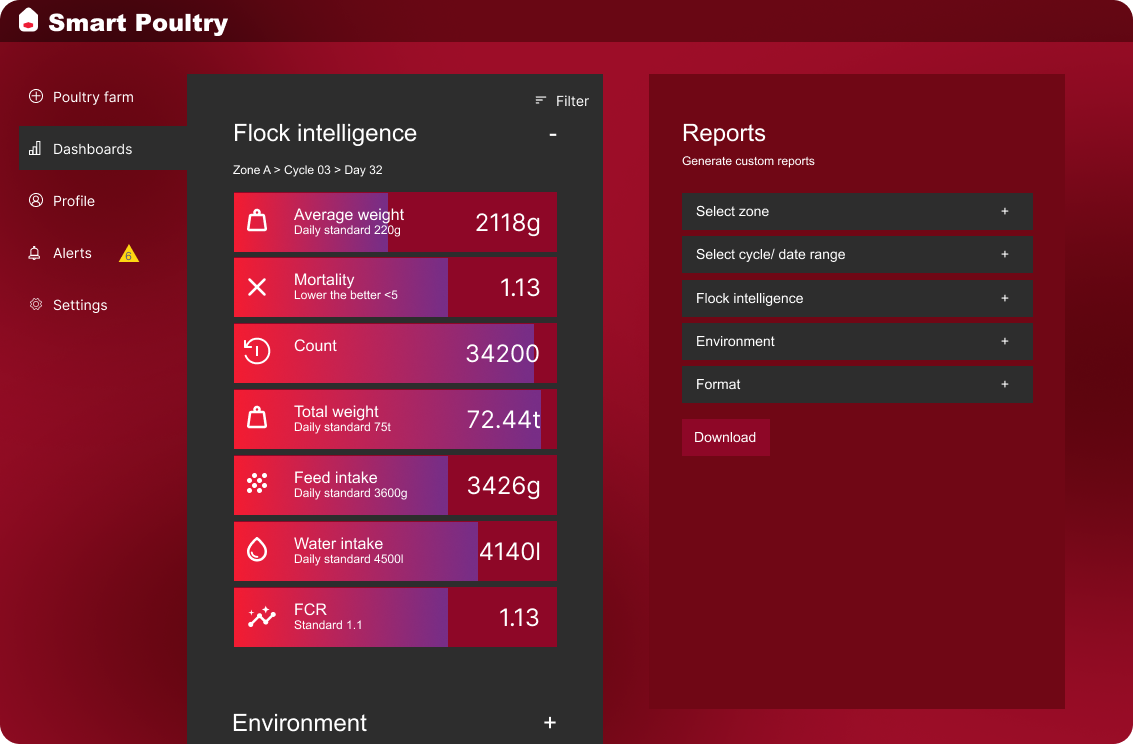
The system pairs ceiling-mounted wide-angle IP cameras with on-premise edge computing nodes running an optimized YOLO object tracking model calibrated for poultry morphology. Optical bounding volumes are converted to real mass using empirical density coefficients adjusted for bird age and plumage density.
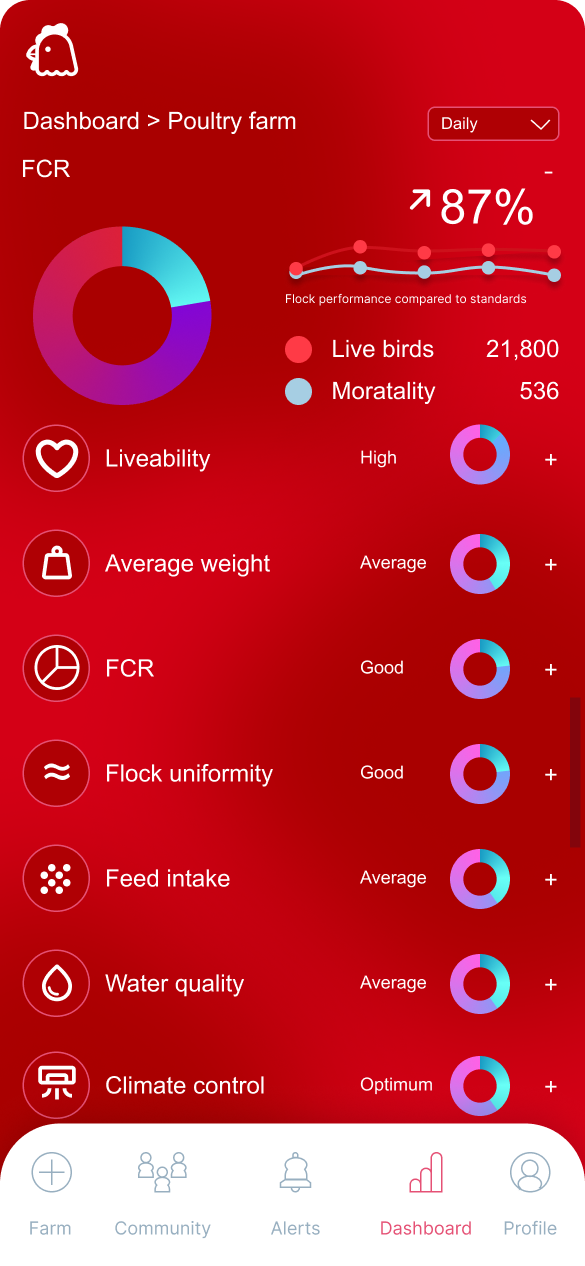
The interface deploys an authentic high-contrast crimson Red UI theme specifically developed for low-light agricultural sheds. In dim tunnel houses lit by low-lux sodium lamps, standard blue or green software interfaces suffer heavy optical glare and washout on rugged tablets. The red palette protects operator night vision and prevents light flicker from disturbing flock circadian rhythms.
Lean Business Model Canvas
- 5–15% mortality risk during tropical heatwaves.
- Manual weighing stresses broilers and causes sampling error.
- FCR inflation of 0.1 destroys contract farmer margins.
- Integrated poultry conglomerates (CP, Leong Hup, Huat Lai).
- Independent contract broiler farmers (20k–100k capacity).
- Commercial egg layer facilities seeking automated bird count.
- Contactless 24/7 automated weight estimation (±2.5% accuracy).
- Automated early heat-stress and mortality anomaly detection.
- Sub-ppm ammonia telemetry integrated with ventilation controls.
- Hardware installation deposit (cameras, edge box, sensor bus).
- Per-bird software cycle fee ($0.012 to $0.018 per bird sold).
- Enterprise dashboard integration for multi-farm integrators.
- Wide-angle IP camera optics and industrial edge compute nodes.
- Electrochemical NH₃ sensor recalibration and maintenance.
- Model retraining for diverse plumage and lighting variations.
- Proprietary optical volume-to-biomass algorithm calibrated on 100k+ birds.
- Integrated telecommunication hardware architecture for rural low-connectivity sheds.